
Blue Mallee vs Globulus: Which Eucalyptus Oil Are You Actually Buying?
Same familiar scent. Different species. And a story worth knowing.
There's something unmistakable about eucalyptus oil.
That crisp, refreshing aroma. The scent of the Australian bush. The kind of fragrance that makes a room feel instantly fresher.
But here's something you might not know.
Not every bottle labelled eucalyptus oil comes from the same species of tree. And while the differences might seem insignificant, they can tell you quite a lot about what's actually inside the bottle.
At Wattle Grove, we believe that understanding where your eucalyptus oil comes from is just as important as knowing what to do with it.
So, let's get acquainted with two well-known eucalyptus species: Eucalyptus polybractea (Blue Mallee) and Eucalyptus globulus (Tasmanian Blue Gum).
Because when it comes to eucalyptus oil, the details matter.
1. Meet Eucalyptus globulus — The Familiar Blue Gum
Eucalyptus globulus, commonly known as Tasmanian Blue Gum, is one of the best-known eucalyptus species used in essential oil production.
Native to southeastern Australia, particularly Tasmania and Victoria, it has also been widely cultivated internationally.
Its oil is recognised for that familiar, sharp, camphoraceous eucalyptus aroma.
Eucalyptus globulus contains a naturally occurring compound called 1,8-cineole, also known as eucalyptol, which contributes significantly to its distinctive scent.
The amount of cineole can vary depending on the growing conditions, maturity of the leaves and processing methods.
It's a well-established species with a long history of commercial use.
But it's not the only eucalyptus worth knowing about.
2. Meet Eucalyptus polybractea — The Australian Blue Mallee
Now, this is where our story gets a little more personal.
Eucalyptus polybractea, commonly known as Blue Mallee, is an Australian native species recognised for producing eucalyptus oil naturally rich in 1,8-cineole.
Unlike the towering Tasmanian Blue Gum, Blue Mallee grows as a smaller, multi-stemmed mallee.
And it's the species we've chosen to grow on our family farm in Buckleboo, South Australia.
Why?
Because Blue Mallee can naturally produce an exceptionally high concentration of cineole without requiring further processing to increase that concentration.
At Wattle Grove, our eucalyptus oil typically contains 90–92% naturally occurring 1,8-cineole, according to our oil specifications.
We grow it. We harvest it. We steam-distil it.
And we know exactly where it comes from.
No mystery ingredients. No complicated supply chain. Just Australian-grown Blue Mallee, from our farm to your bottle.
That's something we're rather proud of.
3. What Exactly Is 1,8-Cineole?
If you've ever wondered what gives eucalyptus oil its unmistakably fresh aroma, meet 1,8-cineole.
Also known as eucalyptol, it's one of the principal natural aromatic compounds found in many eucalyptus essential oils.
It's largely responsible for that crisp, penetrating scent we've come to associate with eucalyptus.
Different eucalyptus species naturally produce different proportions of cineole and other aromatic compounds.
Why does this matter?
Because the chemical composition helps define an essential oil's fragrance profile and characteristics.
A higher cineole percentage indicates a greater concentration of that particular compound. However, it doesn't automatically mean an oil is better for every purpose.
Quality also depends on authenticity, purity, processing, storage and suitability for its intended use.
For us, the beauty of Blue Mallee is that its naturally high cineole content is achieved without needing to concentrate it through additional distillation.
4. Single Distillation vs Rectification — What's the Difference?
Here's something that doesn't always make it onto the front of a eucalyptus oil bottle.
Not all eucalyptus oils undergo the same processing.
Steam distillation is the process of passing steam through eucalyptus leaves to release their volatile aromatic compounds. The vapour is then cooled and separated to collect the essential oil.
Rectification involves further distillation or fractionation to adjust the oil's composition.
For example, some commercially produced eucalyptus oils are rectified to increase their cineole concentration or achieve a particular specification.
Rectification is an established processing method. It doesn't necessarily mean an oil is synthetic, adulterated or poor quality.
But it does mean the composition has been deliberately adjusted after the initial extraction.
At Wattle Grove, we take a different approach.
Our Blue Mallee eucalyptus oil undergoes one steam distillation only.
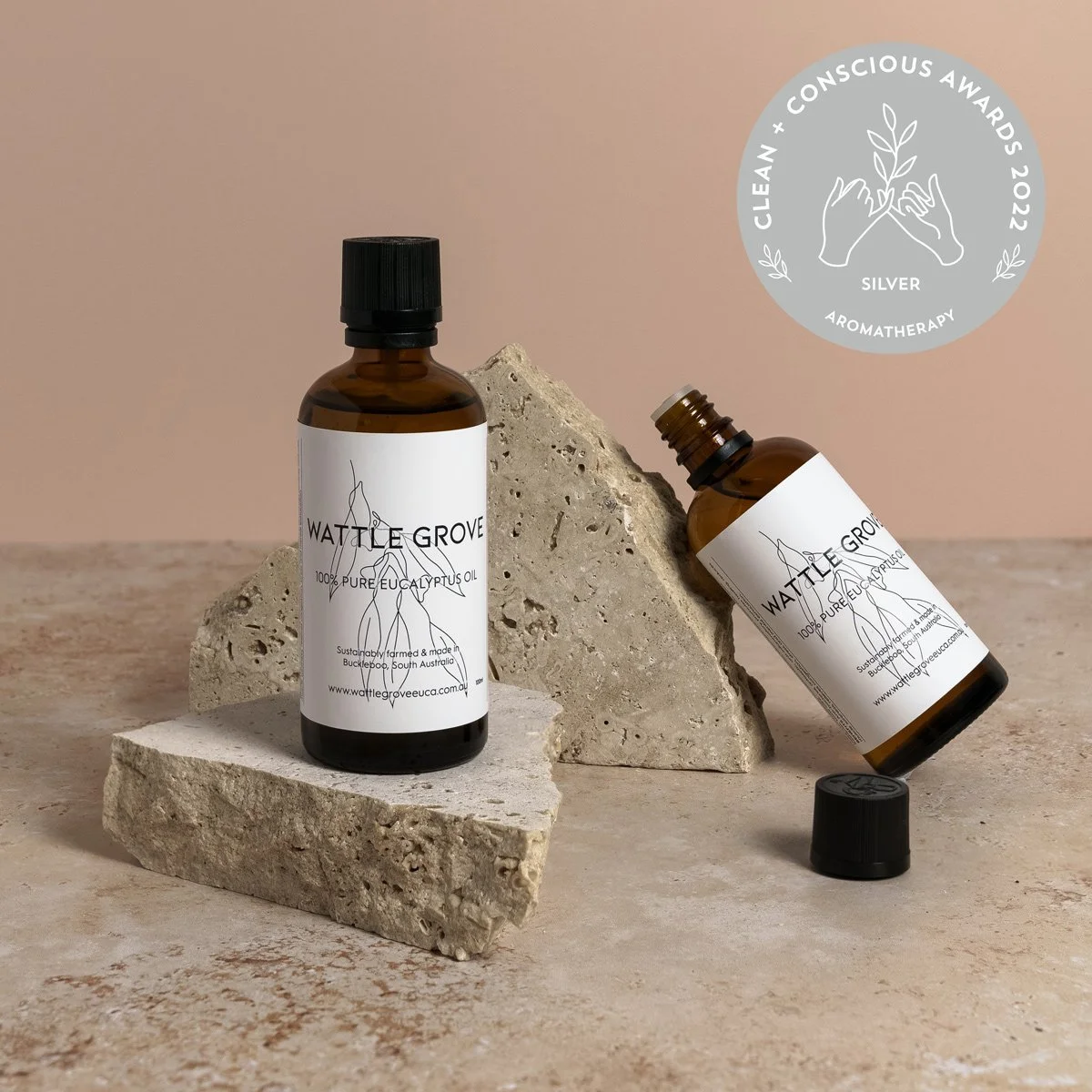
We don't rectify it, blend it with other eucalyptus species or add synthetic fragrance.
The oil is collected with its naturally occurring aromatic composition intact from that initial distillation.
It's a straightforward approach, and one that reflects our philosophy of keeping things as close to nature as practical.
One harvest. One distillation. Nothing unnecessary.
5. Australian Owned Doesn't Always Mean Australian Grown
This is another detail worth paying attention to.
An Australian brand can sell eucalyptus oil sourced from overseas.
And that's not necessarily a problem — eucalyptus oil is produced commercially in many countries.
But if supporting Australian agriculture, understanding provenance and knowing where your ingredients originate matter to you, it's worth looking beyond the branding.
Ask where the eucalyptus trees are grown.
Ask where the oil is distilled.
And look for a clearly identified botanical species.
At Wattle Grove, our story begins in Buckleboo, South Australia.
Our family grows and harvests Blue Mallee eucalyptus trees on our farm, where the leaves are steam-distilled to produce our signature essential oil.
The resulting oil becomes the foundation of our eucalyptus collection and features throughout our home and body products.
We also repurpose the leftover eucalyptus biomass for use in agriculture and other applications.
It's our way of making thoughtful use of what the land provides.
Because beautiful products should have a story worth telling.
And preferably one you can trace back to the source.
6. Five Things to Look for When Buying Eucalyptus Oil
The next time you're shopping for eucalyptus oil, turn the bottle around.
The information on the label can tell you more than the marketing on the front.
Here's our five-point checklist:
Botanical species: Look for a clearly identified name such as Eucalyptus polybractea or Eucalyptus globulus.
Country of origin: Find out where the eucalyptus was grown and where the oil was produced.
Ingredients: A bottle sold as 100% pure eucalyptus essential oil should not contain undisclosed carrier oils or synthetic fragrance.
Extraction method: Check whether the oil is steam-distilled and whether the supplier provides information about additional processing.
Quality information: Look for a transparent supplier who can explain their sourcing, processing and product specifications.
One important distinction: rectified eucalyptus oil can still be genuine, pure eucalyptus oil.
The real question is whether the label accurately describes what you're purchasing.
Transparency matters.
And when a brand is proud of where its ingredients come from, that information shouldn't be difficult to find.
7. So, Is Blue Mallee Better Than Eucalyptus Globulus?
We might be a little biased towards Blue Mallee.
After all, we've dedicated a considerable part of our lives to growing it.
But the answer isn't quite as simple as declaring one species universally better than another.
Both can produce genuine, high-quality eucalyptus essential oil.
Eucalyptus globulus has an established place in the essential oil industry, while Blue Mallee is particularly valued for its naturally high cineole content.
The right choice depends on what you're looking for.
For Wattle Grove, Blue Mallee offers something that aligns beautifully with our values: a distinctive Australian botanical, naturally high cineole content and a direct connection between the farm and the finished product.
We believe in knowing our ingredients.
We believe in understanding how they're produced.
And we believe that when nature gives you something remarkable, there's no need to overcomplicate it.
8. A Little Note on Using Eucalyptus Oil Safely
Eucalyptus essential oil is highly concentrated, regardless of which species it comes from.
Natural doesn't automatically mean harmless.
Always follow the product's directions, dilute appropriately before skin application, and avoid contact with the eyes and sensitive areas.
Never ingest eucalyptus essential oil. Keep it securely stored away from children and pets, and seek professional advice before using it around young children or animals.
The strength of an essential oil is something to respect, not something to experiment with.
The Wattle Grove Difference
We don't believe eucalyptus oil needs an elaborate story.
Just an authentic one.
Ours begins with Blue Mallee trees growing beneath the South Australian sky.
From harvesting and steam distillation to the finished bottle, we're involved in every stage of producing our eucalyptus oil.
No added fragrance. No blending. No rectification.
Just 100% pure Australian Blue Mallee eucalyptus essential oil, grown and distilled with care.
From our farm to your home. Exactly how nature intended.
Discover our 100% Pure Australian Blue Mallee Eucalyptus Oil.
Wattle Grove Eucalyptus Oil — Essence of Wonder.
What is the difference between Eucalyptus globulus and Eucalyptus polybractea?
Eucalyptus globulus, commonly known as Tasmanian Blue Gum, and Eucalyptus polybractea, known as Blue Mallee, are two different Australian eucalyptus species. Both produce essential oils containing 1,8-cineole, but their natural chemical compositions can differ. Blue Mallee is particularly recognised for its naturally high cineole content.
Is Blue Mallee eucalyptus oil pure?
Blue Mallee eucalyptus oil can be sold as 100% pure essential oil when it contains only oil derived from Eucalyptus polybractea, without added carrier oils or synthetic fragrance. Wattle Grove's Blue Mallee oil is single steam-distilled, with no blending or rectification.
What does single-distilled eucalyptus oil mean?
Single-distilled eucalyptus oil is collected from an initial distillation process without undergoing subsequent rectification to modify its composition. This allows the oil to retain the aromatic profile obtained during its original extraction.
